
Nobody wants to admit how much of the day they spend sitting. But if you actually tally it up, the number is uncomfortable. Commute, desk, lunch, desk again, couch, bed. For a lot of Canadians who moved to home offices over the past few years, it’s even worse since the commute disappeared and the desk hours quietly expanded to fill the gap.
People have been using standing desks long enough now that the conversation has shifted. It’s not about whether they work anymore. People are genuinely using them and saying they can’t imagine going back, which is more persuasive than any product review.
The sitting problem is real, and it compounds
Chronic sitting shows up in the body in ways that are easy to ignore until they aren’t. Lower back that never quite loosens up. Hips that feel stiff by mid-morning. That dull ache between the shoulder blades that you’ve started accepting as normal. None of it arrives suddenly. It just settles in over months and years until it’s the baseline.
What makes it tricky is that going to the gym doesn’t cancel it out. Six hours of sitting with your neck at a slightly wrong angle doesn’t get undone by a workout before breakfast. The damage, if you want to call it that, happens in the long stretches in between.
A standing desk doesn’t solve all of this. But it gives you options in those in-between hours, and options turn out to matter more than you’d expect.
What actually changes when you start standing
The main benefit isn’t calories burned or muscles worked. It’s that your body stops being completely static. When you stand, your weight shifts, your feet adjust, your core does a little something without you asking it to. Nothing dramatic, but you’re not locked in place either.
After a few weeks, the people who use these desks regularly tend to notice things they weren’t expecting. The lower back tension that used to build through the afternoon shows up less. The 2pm energy crash is duller or shorter. The end-of-day feeling of having been wrung out by the chair just isn’t as heavy. Small things, but they add up across a week.
Height adjustability is the whole point
An adjustable desk fixed at standing height trades one problem for another. The point isn’t to stand all day, it’s to have the choice. Lower it for focused work in the morning when you want to be settled and still. Raise it after lunch when your energy dips and staying seated feels like giving in. Drop it again whenever you feel like it. That back-and-forth across the day is where the actual benefit comes from.
Electric mechanisms have gotten much more reliable and affordable in recent years. Memory presets for your sitting and standing heights are worth having because they remove the friction of manual adjustment and make you far more likely to actually use the feature. The best standing desk is the one you adjust without thinking about it.
Getting the setup right (the part people skip)
Buying the desk is the easy part. What trips most people up is that they raise it to standing height, notice their neck feels weird after an hour, and assume the desk isn’t working. Usually the desk is fine. The rest of the setup just hasn’t caught up.
Your monitor needs to move when the desk does. A lot of people forget this. Leave your screen sitting flat on the desk surface and it’ll be too low when you’re standing, pulling your chin down for hours at a stretch. Eye level means eye level: the top of the screen roughly where your gaze lands naturally when your head is straight.
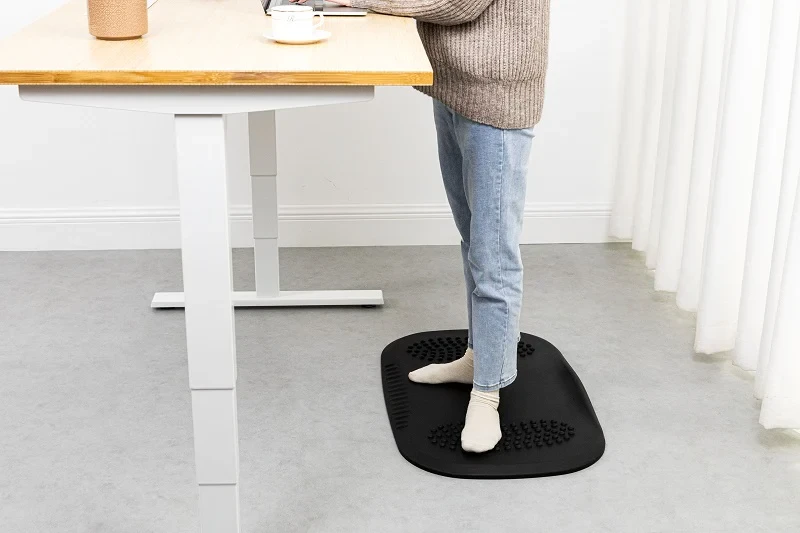
The floor situation matters more than it sounds. Standing on a hard floor for extended periods gets uncomfortable quickly. That discomfort is usually what makes people abandon the standing habit before it’s had time to stick. A decent anti-fatigue mat lets you shift your weight around without thinking about it, which is actually the point. And if you’re working from home, shoes matter. A few days of standing in socks on hardwood will teach you that lesson on its own.
Keyboard and mouse placement is the last thing to check. Your elbows should sit at roughly 90 degrees with your shoulders down and relaxed. If you catch yourself hunching or lifting your arms to reach the keyboard, the surface is too high.
None of this takes long to sort out. But if you skip it, you’ll blame the desk for problems that are really just setup issues.
Home office vs. traditional office
In a regular office, you’re working with what’s there. Whatever the floor plan allows, whatever was on the approved equipment list two years ago. Worth asking anyway. A lot of employers have loosened up on ergonomic requests, especially for people splitting time between home and office. A well-framed request backed by some research is often enough to get the green light.
At home, none of that applies. You buy what you want, set it up how you want, and adjust it without asking anyone. That control is more valuable than it sounds when you’re thinking about a setup you’ll use every day for years.
One thing that catches people off guard: they stand more consistently at home than they ever did in an office. In a shared workspace there’s always that low-level awareness of how you look relative to everyone else sitting around you. At home that’s gone entirely. It’s just you and the desk, and you stop thinking about it.